If you’ve spent any time in the world of premium leather goods, you’ve likely heard the phrase “the diamond of leathers” — and nothing earns that title quite like shell cordovan. But even among shell cordovan aficionados, one name stands apart: Shinki Hikaku (新喜皮革), a boutique Japanese tannery quietly producing what many consider the most refined, most coveted horsehide leather on earth. Founded in 1951 in Kobe, Japan, Shinki Hikaku has spent over seven decades perfecting a process that takes months — yielding a leather so pure, so lustrous, and so rare that owning a piece of it feels like carrying a small treasure. In this deep-dive guide, we explore what makes Shinki Hikaku shell cordovan truly extraordinary: the history, the production process, how it compares to Western cordovan, how it ages, how to care for it, and what products are worth seeking out.
Whether you’re a leather collector, a craftsperson, or simply someone considering their first shell cordovan purchase, this is your complete resource on the rarest leather from Japan.
📋 Table of Contents
- What Is Shell Cordovan? The Basics
- Shinki Hikaku: A Legacy Since 1951
- The Production Process: Six Months of Patience
- Shinki Hikaku vs. Horween: How Do They Compare?
- Colors & Varieties of Shinki Shell Cordovan
- What Products Are Made with Shinki Shell Cordovan?
- Patina & Aging: How Shinki Cordovan Changes Over Time
- How to Care for Shell Cordovan
- Where to Buy Shinki Hikaku Shell Cordovan Products
- FAQ
🐴 What Is Shell Cordovan? The Basics
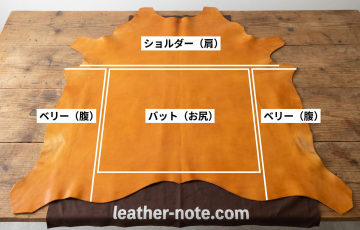
Shell cordovan is not ordinary leather. While most leather goods are made from cowhide or pigskin, shell cordovan comes from an entirely different source and an entirely different part of the animal. It is derived from the rump area of a horse’s hide — specifically from a dense, fibrous membrane called the “shell,” or cordovan membrane, found just beneath the skin and above the muscle in the hindquarters.
What makes this particular layer so special? The fibers in this region are extraordinarily dense, uniform, and tightly packed — unlike the looser, more porous grain of cowhide. This density gives shell cordovan its signature properties:
- Non-creasing surface — Shell cordovan does not fold and crack the way cowhide does. Instead, it gently ripples and rolls, maintaining its smooth, unbroken surface even after years of use.
- Mirror-like luster — The dense fiber structure accepts polish and develops a deep, glass-like shine that is virtually impossible to achieve with cowhide.
- Exceptional durability — Because of its density, shell cordovan resists abrasion, water spots, and daily wear far better than conventional leather.
- Beautiful patina — Over time, shell cordovan develops a rich patina that tells the unique story of its owner, growing more beautiful with every year of use.
One horse yields only two small oval pieces of shell cordovan — one from each side of the rump. This extreme scarcity, combined with the labor-intensive production process, makes shell cordovan one of the most expensive leathers in the world.
The origins of cordovan leather trace back to 7th-century Córdoba, Spain, where Visigoth craftspeople first developed the technique. By the early 19th century, the process had spread to Germany, and eventually to the United States — most famously to Chicago’s Horween Leather Company. But in the post-war era, Japan quietly began developing its own tradition of shell cordovan production, and today, Shinki Hikaku stands at the pinnacle of that tradition.
🏭 Shinki Hikaku: A Legacy Since 1951
Shinki Hikaku Co., Ltd. (新喜皮革株式会社) was founded in 1951 in Kobe, Japan, in the Hyogo Prefecture — a city with deep roots in Japan’s leather industry. From day one, the tannery made a singular choice: to specialize exclusively in horse leather, including shell cordovan and a range of premium horsehide products. This singular focus has allowed Shinki Hikaku to develop a depth of expertise and quality control that generalist tanneries simply cannot match.
Over seven decades, Shinki Hikaku has become the most revered and most expensive horsehide producer in the world. Their leather has attracted a devoted following among leather craftspeople, bespoke shoemakers, and artisan goods makers across North America, Europe, and Asia. Rocky Mountain Leather Supply — the official North American distributor of Shinki Hikaku — describes the tannery as one of the few remaining producers of shell cordovan in the entire world.
What distinguishes Shinki Hikaku from other producers is not just their technique, but their philosophy. As a boutique tannery, they emphasize delicate craftsmanship and continuous improvement in technology. They do not rush production. They do not cut corners. Every hide goes through an exacting process from start to finish, and only hides that meet their strict standards leave the tannery.
The raw horse hides used by Shinki Hikaku are imported from Europe, where animal welfare regulations ensure that horses are raised and slaughtered according to strict standards. The hides come specifically from horses used in the food industry at the end of their working lives — a byproduct of the meat industry that would otherwise go to waste. This ethical sourcing is an important part of Shinki Hikaku’s story.
⚙️ The Production Process: Six Months of Patience
The production of Shinki Hikaku shell cordovan is one of the most demanding and time-consuming processes in all of leatherworking. From raw hide to finished leather, the entire cycle takes a minimum of four to six months — and much of that time, the leather simply sits and rests, curing and developing its character the way fine whisky matures in a barrel.
Here is an overview of the key stages:
1. Hide Selection and Initial Processing
Incoming European horse hides are carefully inspected and sorted. Only hides with the right density, thickness, and lack of scarring are accepted. Each hide is then cut into two sections — the butt (hindquarter) and the fronts. The butt section contains the cordovan membrane that will eventually become shell cordovan. The hides undergo thorough washing, dehairing, and fat removal before tanning begins.
2. Mimosa Vegetable Tanning
Shinki Hikaku uses mimosa tannage — a traditional vegetable tanning method using bark imported from Australia, dissolved in water to create a rich tanning bath. The hides are immersed in this solution and left to soak for an extended period, allowing the tannins to penetrate deeply and evenly throughout the dense cordovan fiber layer. This slow, patient tanning is what gives Shinki cordovan its characteristic firmness, its ability to develop a natural shine, and its long-term durability.
3. Drying and Curing
After tanning, the hides are removed from the bath, dried, and then stored for additional months to cure and shrink properly. This waiting period is critical — rushing this stage would compromise the density and quality of the final shell. It is during this phase that the leather develops its internal structure and the tight fiber alignment that makes shell cordovan unique.
4. Skiving and Extracting the Shell
Once cured, skilled artisans carefully skive (shave) the hide from the flesh side to expose and extract the cordovan membrane itself. This is one of the most delicate stages of the process — the shell is an internal layer, not the outer skin, and it must be separated with great precision to avoid damaging it. This is the part that gives shell cordovan its distinctive characteristic: the surface we see is actually the flesh side of the leather, not the grain side.
5. Dyeing, Hand Finishing, and Glazing
The extracted shells are dyed to the desired colors, then hand-slicked to even out the color. After drying, each shell receives careful hand finishing, which may include the application of oils and conditioners to nourish the leather. Finally, Shinki’s glazing process compresses and aligns the surface fibers using specialized equipment, producing the extraordinary luster that Shinki cordovan is known for.
⚔️ Shinki Hikaku vs. Horween: How Do They Compare?
For most English-speaking leather enthusiasts, the name Horween — Chicago’s legendary tannery, operating since 1905 — is synonymous with shell cordovan. Horween’s shell cordovan is widely regarded as a gold standard, beloved for its firm temper, rich colors, and superb resistance to water spotting. But the world of shell cordovan does not begin and end with Horween, and Shinki Hikaku offers a meaningfully different experience.
Here’s how the two compare across key attributes:
| Attribute | Shinki Hikaku (Japan) | Horween (USA) |
|---|---|---|
| Founded | 1951, Kobe, Japan | 1905, Chicago, USA |
| Tanning method | Mimosa vegetable tannage | Mixed tannage (veg + chromium) |
| Surface feel | More polished, less waxy | Slightly waxy, more “shell-like” |
| Luster | Clean, refined, high-gloss | Deep, rich, slightly matte finish initially |
| Thickness | ~4 oz / 1.6mm (slightly thinner) | ~4–5 oz |
| Color range | Very wide (including unique colors) | Classic range (Color 8, Whiskey, Black, etc.) |
| Water resistance | Good | Excellent (especially against water spots) |
| Best for | Small leather goods, watch straps, wallets | Footwear, larger leather goods |
| Price | Premium (~$110+ per piece) | Premium (~$90–130+ per piece) |
The consensus among experienced leather craftspeople is that Shinki Hikaku and Horween each have their strengths. Horween excels for footwear because of its slightly firmer temper, exceptional water spotting resistance, and the rich, complex finish that develops on shoes over years of wear. Shinki Hikaku, by contrast, is considered superior for small leather goods — its cleaner surface, more refined luster, and slightly softer character make it ideal for wallets, card holders, and watch straps where visual precision is paramount.
Many craftspeople and connoisseurs describe Shinki’s surface as “cleaner and more uniform” than Horween — showing off deeper color tones and a more consistent sheen across the entire piece. For those who value absolute aesthetic perfection, Shinki is often the preferred choice.
🎨 Colors & Varieties of Shinki Shell Cordovan
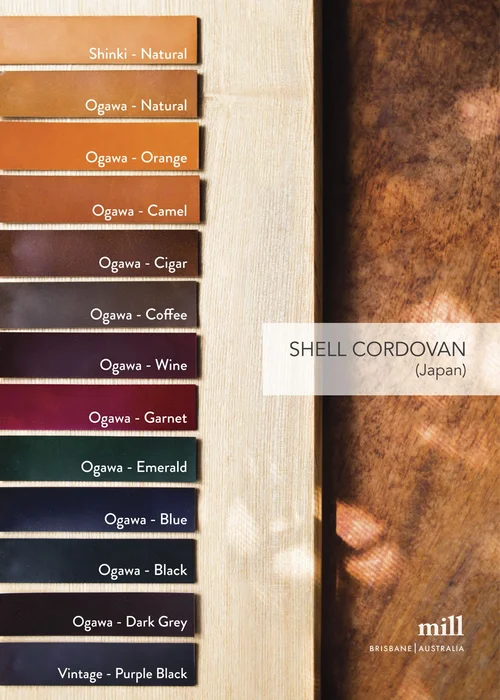
One of the most exciting aspects of Shinki Hikaku shell cordovan is its remarkable range of colors — far broader than what Horween typically offers. While Horween is associated with its classic palette (Color 8 burgundy, Whiskey, Black, Natural), Shinki Hikaku offers all of these plus a range of unique and bold colorways that are rarely seen in shell cordovan.
Common Shinki Hikaku shell cordovan colors include:
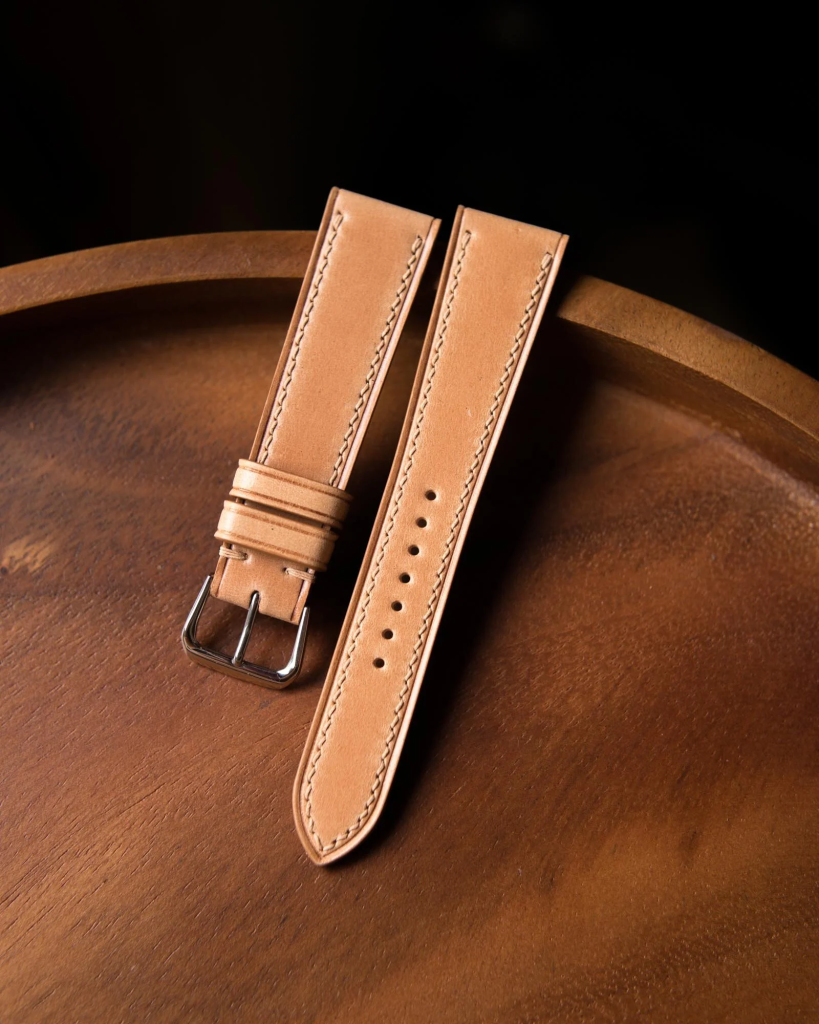
- Natural — The undyed, full aniline state. One of the most difficult colors to produce, as most shells are naturally too dark. Develops dramatic amber and golden-brown patina over time.
- Black — Classic, clean, and elegant. Develops subtle undertones over years of wear.
- Burgundy / Color 8 — A deep, rich red-brown that is perhaps the most iconic shell cordovan colorway.
- Whiskey / Cognac — A warm amber-brown that develops beautiful golden tones with age.
- Olive Green — A distinctive, earthy color rarely found in shell cordovan from other tanneries.
- Emerald Green — Bold and vibrant, a favorite for statement pieces.
- Deep Blue / Navy — A cool, sophisticated option for those who want something unconventional.
- Cedar — A rich, warm reddish-brown.
- Mahogany — Deep, chocolatey brown with warm undertones.
- “Matte” variants — A special finish that skips the glazing process for a more subdued, understated appearance that develops an even more dramatic patina over time.
Shinki Hikaku also produces several other premium horse leather products beyond shell cordovan, including Oiled Horsebutt, Antique Horsehide, and Shrunken Horsebutt — each with its own distinctive character and application.
👜 What Products Are Made with Shinki Shell Cordovan?
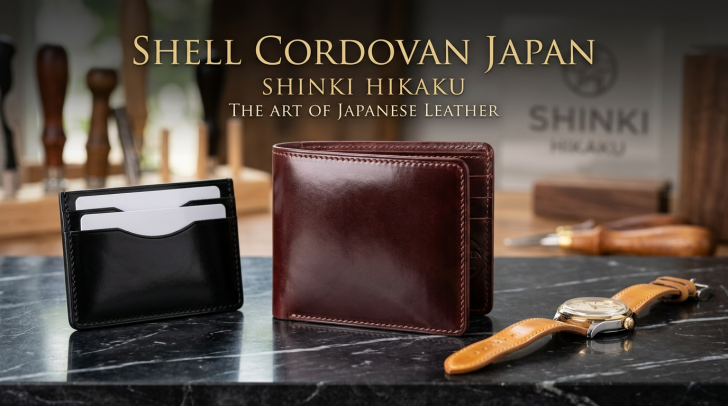
Because of Shinki Hikaku’s slightly thinner and softer character compared to Western shell cordovan, it is considered especially well-suited for small leather goods and items that require precision and fineness. The most common applications include:
💳 Wallets & Card Holders
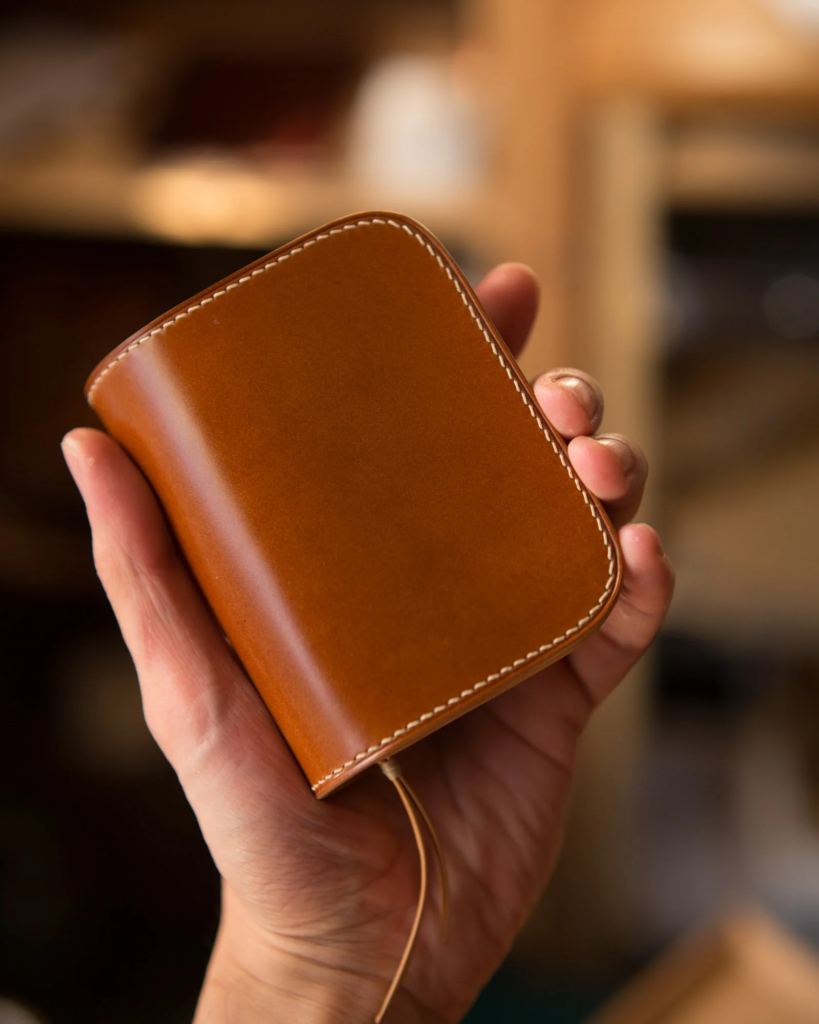
Shell cordovan wallets are perhaps the most popular application. The non-creasing property of shell cordovan is ideal here — a cowhide wallet will crease and break down at the fold lines over years of use, while a shell cordovan wallet simply ripples and maintains its smooth, intact surface. The natural oils in your hands also condition the leather continuously, accelerating the development of a beautiful patina. Artisan makers like Guarded Goods produce wallets from Shinki Hikaku shell cordovan in a range of colors and styles.
⌚ Watch Straps
Watch strap makers worldwide prize Shinki Hikaku shell cordovan for its combination of elegance, durability, and aging character. Singapore-based Delugs — which has sold over 100,000 straps to watch collectors globally — notes that shell cordovan is particularly at home as a watch strap because it tends to ripple rather than crease, and that Shinki Hikaku’s version is “extremely clean and uniform,” able to show off cool tones and depth of colour in ways that other shell cordovans cannot.
👟 Shoes & Boots
While Shinki Hikaku cordovan is perhaps more associated with small leather goods than footwear, it absolutely has a place in high-end shoemaking. John Lofgren Bootmaker, for example, produces Combat Boots using Shinki Natural Shell Cordovan at a price point of $1,650 — representing the pinnacle of what shell cordovan footwear can be. The slightly softer character of Shinki cordovan compared to Horween means a faster break-in period without sacrificing durability.
🔗 Belts & Other Accessories
Shell cordovan belts are a statement of commitment to quality. A shell cordovan belt will outlast multiple cowhide belts, resist cracking and creasing at the buckle point, and develop a rich patina along its length. Other accessories made from Shinki Hikaku shell cordovan include key fobs, lanyards, passport holders, and custom accessories for bespoke craftspeople.
🌟 Patina & Aging: How Shinki Cordovan Changes Over Time
One of the most compelling reasons to invest in shell cordovan is its extraordinary aging character. Unlike synthetic materials or even many conventional leathers that simply wear out and fade, shell cordovan grows more beautiful with use. This transformation — called patina — is the central joy of owning a shell cordovan product.
Shinki Hikaku Natural Shell Cordovan in particular offers dramatic patina potential. Starting as a pale, almost cream-colored leather in its undyed state, it gradually darkens through handling — absorbing the natural oils from your skin — developing rich golden, amber, and eventually whiskey and honey tones over months and years of daily use. The transformation is continuous and deeply personal: no two pieces will age identically, making each item truly one-of-a-kind.
For other colors, the aging process is equally interesting. Darker colors like Black and Burgundy develop increasing depth and complexity over time — as the surface wears and the leather breathes, subtle undertones emerge that were invisible when the leather was new. Color 8 (burgundy) is famous for gradually lightening in color, shifting toward a richer, more complex red-brown that many collectors find even more beautiful than the original.
The key factors that influence how shell cordovan ages include:
- Daily handling — The oils from your hands are the primary accelerant of patina development, especially for wallets and watch straps.
- Sun exposure — Direct sunlight accelerates fading and color lightening; indirect light exposure adds character more gradually.
- Care routine — Brushing and light conditioning preserve the leather’s health and accelerate the development of a natural shine.
- Glazed vs. Matte — Matte (unglazed) shell cordovan tends to absorb oils faster and show more dramatic patina changes early in its life, while glazed shell develops patina more gradually and uniformly.
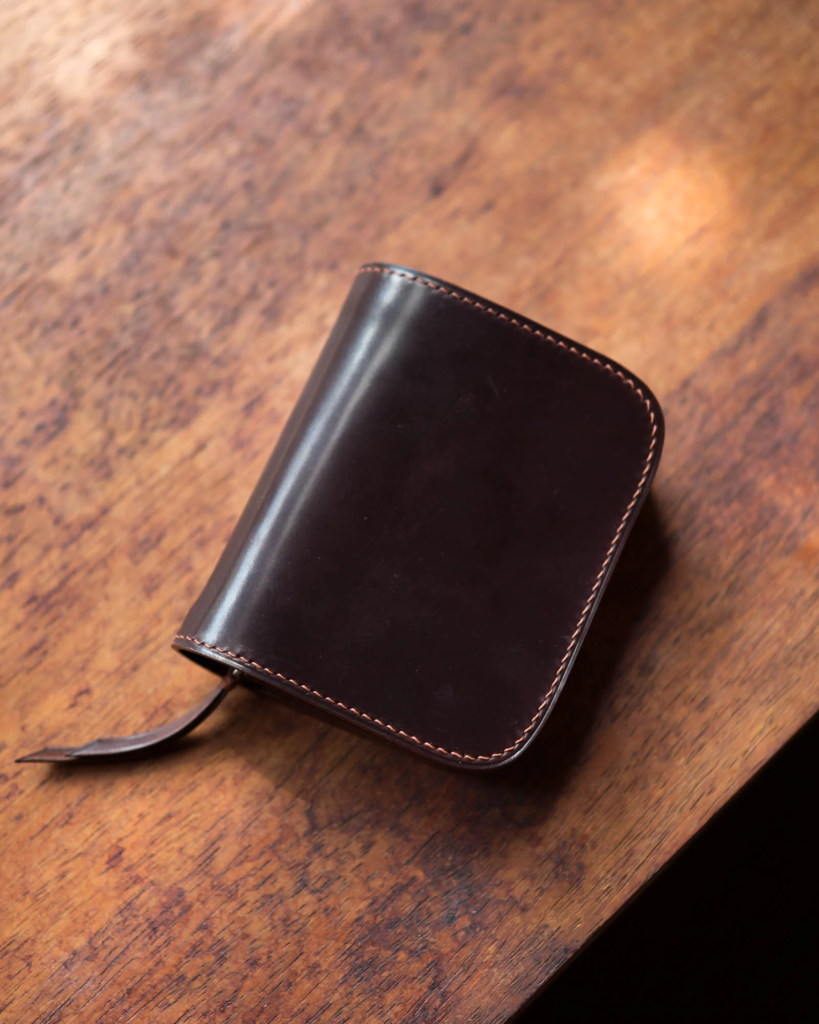
One of the most frequently observed and celebrated characteristics of shell cordovan aging is the development of what collectors call “rolling” rather than “creasing” — even at the fold lines of a wallet or the flex points of a shoe, shell cordovan does not crack or crease the way cowhide does. Instead, it forms smooth, gentle rolls that maintain the leather’s integrity and add visual character over time.
🧴 How to Care for Shell Cordovan
Shell cordovan is significantly easier to care for than most people expect. Its high oil content and dense fiber structure mean it requires far less conditioning than conventional leathers. In fact, over-conditioning can be detrimental — shell cordovan already contains plenty of natural oils and does not need frequent product application.
Daily Care
The most important daily care step for shell cordovan is also the simplest: brushing. A good-quality horsehair brush, used after every wear (for footwear) or every few uses (for wallets and straps), removes dust and dirt while generating gentle heat that brings the natural oils and waxes in the leather to the surface. This alone is often enough to maintain a beautiful shine — no product needed.
For wallets and watch straps, daily handling provides enough conditioning through the natural oils in your skin. Simply carrying a shell cordovan wallet is, in many ways, caring for it.
Conditioning
When conditioning is needed — typically every 6 to 12 months — use a product specifically designed for shell cordovan. Recommended options include:
- Saphir Cordovan Cream — The gold standard for shell cordovan care, providing conditioning, color refreshing, and shine in one step.
- Horween Venetian Shoe Cream — A gentle, widely respected conditioner that works well on shell cordovan without over-saturating it.
- Neutral wax polishes — For footwear, a neutral or color-matched wax polish can enhance shine and provide water resistance.
Apply a small amount with a soft cloth, allow it to penetrate for a few minutes, then buff with a clean cloth and follow with brushing. Less is more with shell cordovan — a thin, even application is always better than a heavy coat.
Storage
Store shell cordovan items in breathable cloth bags rather than plastic (which traps moisture). For footwear, always use cedar shoe trees to maintain shape and absorb moisture. Avoid folding shell cordovan items or storing them in positions that would create sharp pressure points. Keep items away from direct sunlight and excessive heat, which can dry out the leather and cause premature fading.
Dealing with Water Spots and Scuffs
Shell cordovan is naturally resistant to water spots — more so than most leathers — but it is not entirely waterproof. If your shell cordovan gets wet, allow it to dry naturally away from heat sources, then brush and condition as needed. For minor scuffs, often all that is needed is gentle rubbing with a clean fingertip or cloth, which redistributes the leather’s natural oils and eliminates the scuff. For deeper scuffs on shoes, a small amount of Saphir Cordovan Cream applied with a polishing bone can restore the surface.
🛒 Where to Buy Shinki Hikaku Shell Cordovan Products
Finding Shinki Hikaku shell cordovan products can require some searching — this is not a leather you’ll find at a department store. Here are the best sources:
🌐 Specialist Retailers & Makers
- Rocky Mountain Leather Supply — The official North American distributor of Shinki Hikaku. If you are a leatherworker or craftsperson, this is where to source raw hides and panels. They carry the full range of Shinki colors.
- Guarded Goods — Produces handcrafted wallets, belts, and watch straps from Shinki Hikaku shell cordovan. Made in the USA with exceptional attention to detail.
- Delugs — A top-tier watch strap maker using Shinki Hikaku shell cordovan. Ships globally from the USA and Singapore.
- Craft and Antler Co. — Shinki Hikaku shell cordovan goods and information.
- Grommet’s Leathercraft — Artisan wallets made from Shinki Hikaku shell cordovan in unique colors including Emerald Green and Olive.
🛍️ Amazon
While Shinki Hikaku shell cordovan goods are less commonly found on Amazon compared to specialist sites, there are options available — particularly for leather care products and occasionally for small accessories. Search for “shell cordovan wallet Japan” or “horsehide cordovan leather goods” to find current listings. For care products, we recommend:
- Saphir Cordovan Cream Polish — The essential care product for any shell cordovan item.
- Horsehair Brush for Leather Care — For daily maintenance of shell cordovan shoes and goods.
🇯🇵 Japanese Market (Rakuten / Yahoo Shopping)
For those who can navigate Japanese e-commerce, there are excellent options for Shinki Hikaku shell cordovan products on Rakuten. Search for 「新喜皮革 コードバン」 (Shinki Hikaku Cordovan) to find a range of wallets, shoes, and accessories made by Japanese craftspeople directly with Shinki leather. Prices are often competitive with international options, and quality from established Japanese makers is consistently high.
Notable Japanese products to look for on Rakuten include:
- コードバン長財布(Cordovan Long Wallet) — Full-length wallets in Shinki Hikaku shell cordovan, often with multiple card slots and coin pockets
- コードバン二つ折り財布(Cordovan Bifold Wallet) — Classic bifold wallets showcasing the leather’s clean surface
- コードバン名刺入れ(Cordovan Business Card Holder) — A popular Japanese accessory in shell cordovan
❓ Frequently Asked Questions (FAQ)
Q: Is Shinki Hikaku shell cordovan better than Horween?
Neither is universally “better” — they are different, and the right choice depends on the application. Shinki Hikaku is widely considered superior for small leather goods like wallets and watch straps, where its cleaner surface, more polished luster, and uniform color are especially valuable. Horween is generally preferred for footwear, particularly because of its superior resistance to water spotting and its slightly firmer temper that holds up better under the stresses of walking. Many serious leather enthusiasts collect pieces made from both.
Q: How long does Shinki Hikaku shell cordovan last?
With proper care, shell cordovan items can last multiple lifetimes. It is not uncommon for shell cordovan shoes to be resoled many times before the upper leather shows any significant wear. A shell cordovan wallet or watch strap, with basic care, should outlast many decades of daily use — and become more beautiful in the process. Shell cordovan is one of the few materials that genuinely improves with age and use.
Q: Why is Shinki Hikaku shell cordovan so expensive?
The high price reflects multiple factors: (1) the extreme scarcity of the raw material — only two small oval pieces per horse; (2) the labor-intensive, months-long production process; (3) the high rejection rate of hides that do not meet Shinki Hikaku’s standards; (4) the importation of hides from Europe; and (5) the global demand that often outstrips supply. At Rocky Mountain Leather Supply, Shinki Hikaku shell cordovan typically starts around $110 per piece for a single shell — and prices only go up from there for finished goods.
Q: How do I know if a product is genuinely made from Shinki Hikaku shell cordovan?
Buy from reputable makers who explicitly state the tannery source. Established makers like Guarded Goods, Delugs, and Rocky Mountain Leather Supply are transparent about their leather sources. Be skeptical of listings that claim “shell cordovan” without specifying the tannery — true shell cordovan is rare and expensive, and low-priced “shell cordovan” is often neither. Genuine Shinki Hikaku shell cordovan will typically be accompanied by documentation or a clear statement from the maker.
Q: Can I get shell cordovan wet?
Shell cordovan has a naturally dense fiber structure that provides good resistance to water — better than most leathers. However, it is not waterproof. Light rain or occasional splashes will cause no lasting damage if the leather is allowed to dry naturally. Avoid submerging shell cordovan items or exposing them to prolonged moisture. If your shell cordovan gets wet, stuff footwear with newspaper, allow everything to dry away from heat, and then brush and condition as needed once dry.
Q: Where can I see the Shinki Hikaku official website?
Shinki Hikaku’s official website is in Japanese and accessible at shinki.co.jp. For English-language information, Rocky Mountain Leather Supply (rmleathersupply.com) provides the most comprehensive resource as the official North American distributor.
🎯 Final Thoughts: Why Shinki Hikaku Shell Cordovan Is Worth It
In a world flooded with fast fashion and disposable goods, Shinki Hikaku shell cordovan represents the opposite extreme: a material that demands patience in its creation, rewards patience in its use, and delivers beauty that only deepens with the passage of time. It is a leather for people who understand that the finest things are not bought, but earned through years of appreciation.
Whether you are a collector building a curated leather goods collection, a craftsperson searching for the perfect material for a special project, or simply someone who wants to invest in something that will last — Shinki Hikaku shell cordovan is as close to perfection as leather gets.
The next time you reach into your pocket for a wallet, glance at the strap on your wrist, or slip on a pair of shoes — imagine how that object might look in ten, twenty, thirty years if it were made from the finest leather Japan has ever produced. That is the promise of Shinki Hikaku shell cordovan: an heirloom in your hands, from the moment you first hold it.
Have questions about Shinki Hikaku shell cordovan or shell cordovan in general? Feel free to leave a comment below — we’d love to hear from fellow leather enthusiasts around the world.