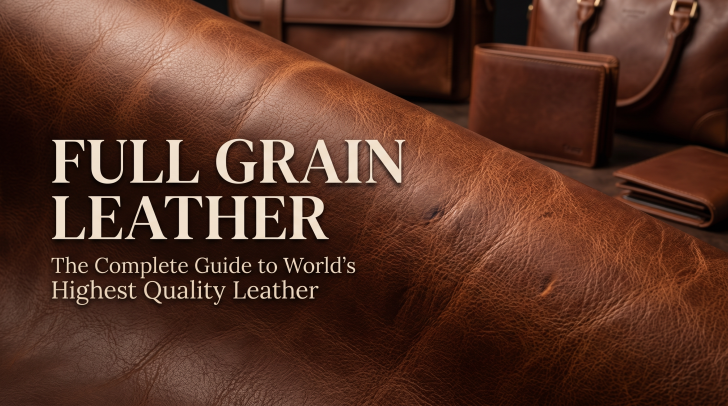
If you’ve ever shopped for a quality leather wallet, jacket, or bag, you’ve probably come across the term “full grain leather” — often described as the gold standard of leather. But what exactly makes it so special, and is it really worth the higher price tag? In this complete guide, we’ll break down everything you need to know about full grain leather, from how it’s made to how it ages beautifully over decades of use.
📋 Table of Contents
- What is Full Grain Leather?
- Understanding Leather Grades: Where Full Grain Stands
- Key Characteristics of Full Grain Leather
- How to Identify Genuine Full Grain Leather
- The Beauty of Patina: How Full Grain Leather Ages
- Pros and Cons of Full Grain Leather
- Care and Maintenance Tips
- Recommended Full Grain Leather Products
- Frequently Asked Questions (FAQ)
- Conclusion
1. What is Full Grain Leather?
Full grain leather is the highest grade of leather available, made from the top layer of an animal hide (usually cowhide) with the entire grain surface left completely intact. Unlike lower grades, it has not been sanded, buffed, or corrected to remove natural marks, scars, or imperfections.
This top layer — the part that sat just beneath the animal’s hair — contains the tightest, strongest fiber structure in the entire hide. By preserving this layer in its natural state, full grain leather retains all of its original durability, breathability, and oil-absorbing qualities. Each piece tells a unique story through subtle wrinkles, pores, and natural markings — no two pieces are ever exactly the same.

2. Understanding Leather Grades: Where Full Grain Stands
To understand why full grain is considered the best, it helps to look at how leather is graded. The hide of an animal has multiple layers, and how those layers are processed determines the grade.
There are four main grades of leather, ranked from highest to lowest quality:
- Full Grain Leather — The top layer of the hide, untouched and unaltered. The strongest and most durable.
- Top Grain Leather — The second-highest grade. The outermost layer is sanded or buffed to remove imperfections, making it thinner and more uniform but less durable.
- Genuine Leather — A misleading marketing term. Made from the lower layers of the hide after the top is removed. Heavily processed and significantly less durable.
- Bonded Leather — The lowest grade. Made by gluing together leather scraps and fibers with polyurethane. Lacks the qualities of real leather.

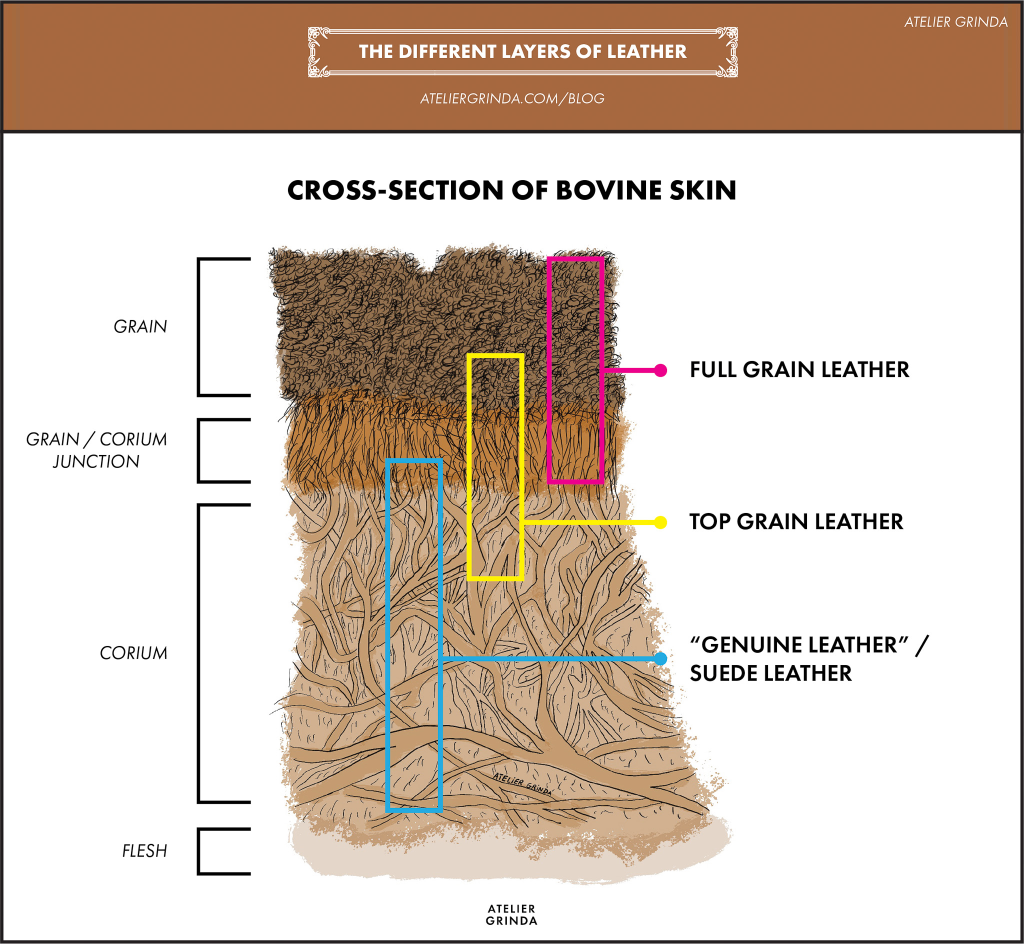
Important: Don’t be fooled by the label “genuine leather.” Despite sounding premium, it actually refers to a lower-grade product. If you want quality, always look specifically for the words “full grain leather.”
3. Key Characteristics of Full Grain Leather
What sets full grain leather apart from every other type? Here are the defining qualities that make it the premium choice for serious leather lovers.
🔹 Exceptional Durability
Because the tight outer fiber structure remains intact, full grain leather is significantly stronger than other grades. With proper care, a full grain leather product can last for decades — often becoming an heirloom passed down through generations.
🔹 Natural Breathability
The natural pores in full grain leather allow air to circulate. This makes products like wallets, gloves, and shoes more comfortable to use, and it helps prevent moisture buildup that can cause damage over time.
🔹 Develops a Beautiful Patina
Perhaps the most beloved trait of full grain leather is its ability to develop a patina — a rich, deep sheen that emerges over years of handling. This is something cheaper leathers and synthetics simply cannot replicate.
🔹 Unique Natural Markings
Wrinkles, scars, brand marks, insect bites — these “imperfections” are not flaws. They are proof of authenticity and give each piece its own personality. If you find leather that looks too perfect and uniform, it’s likely been corrected or stamped artificially.
4. How to Identify Genuine Full Grain Leather
With so many products mislabeled or vaguely described, knowing how to recognize real full grain leather is essential before you spend your money. Here are the most reliable signs.
- Visible pores and natural texture — Look closely at the surface. Real full grain leather has tiny, irregular pores you can see with the naked eye.
- Natural marks and color variation — Slight scars, wrinkles, or shade differences indicate authenticity.
- A waxy, slightly oily feel — High-quality hides retain their natural oils, giving the surface a soft, supple touch rather than a plastic-like feel.
- Substantial weight and thickness — Full grain leather feels heavier and more solid than thinner, processed leathers.
- Distinct natural smell — Real leather has a warm, earthy aroma. Synthetics often smell chemical or like plastic.
5. The Beauty of Patina: How Full Grain Leather Ages
If there’s one feature that makes full grain leather truly magical, it’s patina development. Patina is the natural color and texture transformation that occurs as leather is used, handled, and exposed to light, air, and oils from your skin.
The 4 Stages of Patina Development
- Stage 1 — Brand New (0–3 months): The leather appears fresh with a uniform color and matte or slightly glossy finish. Natural markings are visible but not yet developed.
- Stage 2 — Early Patina (3–12 months): Subtle darkening begins, especially in high-contact areas. Body oils condition the leather from within, softening the surface.
- Stage 3 — Rich Patina (1–3 years): Deep color contrasts emerge. High-touch zones (like wallet edges or bag handles) become noticeably darker and shinier than less-used areas.
- Stage 4 — Vintage Character (3+ years): A fully matured patina with depth, sheen, and individual character that can never be replicated artificially.

Notice how the originally light tan leather has deepened into a rich amber-brown? That transformation is the result of natural body oils, sunlight exposure, and friction — and it cannot be faked. Lower-grade leathers either crack and peel rather than developing this character, or simply look the same as the day they were bought because they’re sealed under heavy artificial coatings.
6. Pros and Cons of Full Grain Leather
While full grain leather is widely regarded as the best, it’s not always the perfect choice for every situation. Here’s a balanced look at its strengths and limitations.
✅ Advantages
- Most durable and long-lasting leather grade — often outliving its owner with proper care
- Develops a unique, beautiful patina over time
- Naturally breathable and comfortable to use
- Each piece is one-of-a-kind due to natural markings
- Eco-friendly choice when sustainably sourced (especially vegetable-tanned)
- Excellent return on investment over the years
❌ Drawbacks
- Higher upfront cost compared to lower grades
- Stiffer when new — requires a “break-in” period
- Visible natural blemishes may not appeal to those wanting a flawless look
- Less stain-resistant than coated top grain leather
- Requires occasional conditioning to stay supple
7. Care and Maintenance Tips
One of the best things about full grain leather is that it doesn’t need much care — but the little care it does need makes a huge difference over the long run. Follow these simple practices to keep your leather healthy for decades.
🧼 Cleaning
For everyday cleaning, simply wipe the surface with a soft, dry cloth to remove dust. For deeper cleaning, use a leather-specific cleaner — never household soap or harsh chemicals, which can strip the natural oils.
💧 Conditioning
Apply a high-quality leather conditioner every 3 to 6 months, depending on use and climate. This restores natural oils and keeps the leather supple, preventing cracks. Use a small amount on a soft cloth and massage in circular motions.
☀️ Storage
- Avoid direct sunlight for long periods — it can fade and dry out the leather
- Keep away from heat sources like radiators and hair dryers
- Store in a humidity-controlled environment (ideally 40–50% humidity)
- Use dust bags or breathable cloth for long-term storage — never plastic
🌧️ Water Protection
If your leather gets wet, blot (don’t rub) with a soft cloth and let it air-dry naturally at room temperature. After fully drying, apply conditioner to restore moisture lost during evaporation.
8. Recommended Full Grain Leather Products
If you’re ready to invest in your first full grain leather product, here are some popular and well-reviewed options worth considering. These have proven their quality through years of customer feedback.
👜 Bags & Backpacks

- Komal’s Passion Leather Vintage Genuine Full Grain Leather Backpack — A widely loved travel-ready backpack available on Amazon, made from premium full grain hide.
- RUSTIC TOWN Full Grain Leather Messenger Bag — A handmade messenger bag perfect for laptops, available on Amazon with strong customer reviews.
👛 Wallets
- RUSTIC TOWN Full Grain Leather Wallet for Men — A handmade vintage bifold available on Amazon, well-rated for craftsmanship and patina development.
- BULL GUARD Full Grain Leather RFID Bifold Wallet — A popular Amazon option featuring full grain leather with built-in RFID protection.
- Anthology Gear Handmade Full Grain Leather Wallet — Crafted from rugged full grain leather for those who prefer minimalist designs.
🧴 Care Products
- Chamberlain’s Leather Milk Conditioner & Cleaner — An all-natural, pH-balanced conditioner highly trusted in the leather community. Available on Amazon and through the official Chamberlain’s website.
- Lexol Leather Conditioner — A long-trusted, affordable option for everyday leather conditioning, available on Amazon.
- Obenauf’s Heavy Duty LP — Excellent for boots and heavily used items needing deeper protection.
Note: Search the product names directly on Amazon or your preferred online marketplace to find current pricing and reviews.
9. Frequently Asked Questions (FAQ)
Q1. Is full grain leather waterproof?
No, full grain leather is not fully waterproof, but it is naturally water-resistant due to its tight grain structure and natural oils. For better protection, you can apply a leather waterproofing wax or spray.
Q2. How long does full grain leather last?
With proper care, full grain leather products can last 20–50 years or more. Many high-quality items become heirlooms passed down through generations. Some studies suggest full grain leather can last up to five times longer than other materials.
Q3. Is full grain leather worth the higher price?
Yes — when you calculate cost per year of use, full grain leather is often cheaper than buying multiple cheap items over time. A $150 wallet that lasts 20 years costs you just $7.50 per year, while a $30 synthetic wallet replaced every 2 years costs $15 per year.
Q4. Why does full grain leather have visible marks?
Because it’s not sanded or buffed, full grain leather retains all the natural marks from the animal — including scars, insect bites, wrinkles, and brand marks. These are signs of authenticity, not flaws.
Q5. Can full grain leather be repaired if scratched?
Yes. Light scratches often blend into the patina naturally over time. Deeper scratches can be reduced by gently massaging in leather conditioner. The natural oils help fibers re-settle and minimize the visibility of marks.
Q6. What’s the difference between full grain and vegetable-tanned leather?
“Full grain” refers to the grade of the leather (the layer of hide used), while “vegetable-tanned” refers to the tanning method (using natural plant tannins). Full grain leather can be either vegetable-tanned or chrome-tanned. Full grain vegetable-tanned leather is widely considered the highest quality combination.
Q7. Does full grain leather smell?
Yes — and that’s a good thing. Real full grain leather has a warm, earthy, natural scent that many people love. If your “leather” item smells like plastic or chemicals, it’s likely synthetic or low-grade.
10. Conclusion
Full grain leather isn’t just a material — it’s an investment in lasting quality. From its unmatched durability and natural breathability to its ability to develop a one-of-a-kind patina, it remains the preferred choice of craftsmen, collectors, and anyone who appreciates goods built to last.
While the upfront cost may be higher than for top grain or genuine leather, the long-term value is undeniable. A well-crafted full grain leather wallet, bag, or pair of boots can serve you faithfully for decades, telling your unique story through every scratch, mark, and shade of patina.
If you’re choosing between cheaper alternatives that need replacing every few years, or one premium full grain piece that will age beautifully alongside you — the answer is clear. Buy once, buy right, and enjoy it for a lifetime.