If you’ve ever shopped for a leather wallet, belt, or bag, you’ve almost certainly run into the terms vegetable tanned and chrome tanned. These two tanning methods sit at the heart of every piece of real leather you’ll ever buy — and they shape almost everything about how that leather looks, feels, ages, and lasts.
The short answer? Veg-tanned leather is the traditional, plant-based method that develops a rich patina over decades. Chrome-tanned leather is the modern, chemical-based method that’s softer, more colorful, and used in roughly 90% of leather goods worldwide. But the full picture is far more interesting — and matters a lot when you’re spending real money on a piece you want to last.
This guide breaks down the real differences with photos, real-world use cases, and a clear recommendation for what to buy depending on your needs.
📖 Table of Contents
- 1. What Is Leather Tanning, Really?
- 2. Vegetable Tanned Leather: The Traditional Method
- 3. Chrome Tanned Leather: The Modern Standard
- 4. Side-by-Side Comparison Table
- 5. Patina & Aging: The Biggest Visual Difference
- 6. Durability, Water Resistance & Daily Use
- 7. Environmental & Health Impact
- 8. Which One Should You Actually Buy?
- 9. Recommended Products on Amazon & Rakuten
- 10. Frequently Asked Questions
What Is Leather Tanning, Really?
Before we compare the two methods, it helps to understand what tanning actually does. A raw animal hide, left untreated, would decompose in days. Tanning is the chemical process that stabilizes the collagen fibers in the hide, transforming a perishable piece of skin into the durable, flexible, beautiful material we call leather.
Every tanning method achieves this same basic goal — but the materials, time, and end result are wildly different. There are several tanning approaches in the world (brain tanning, alum tanning, oil tanning, and more), but the two that dominate global production are vegetable tanning and chrome tanning.
💡 Quick fact: Roughly 90% of all leather produced today is chrome tanned. Vegetable tanned leather is the much rarer, more traditional minority — and that scarcity is a big part of why it commands a premium.

Vegetable Tanned Leather: The Traditional Method
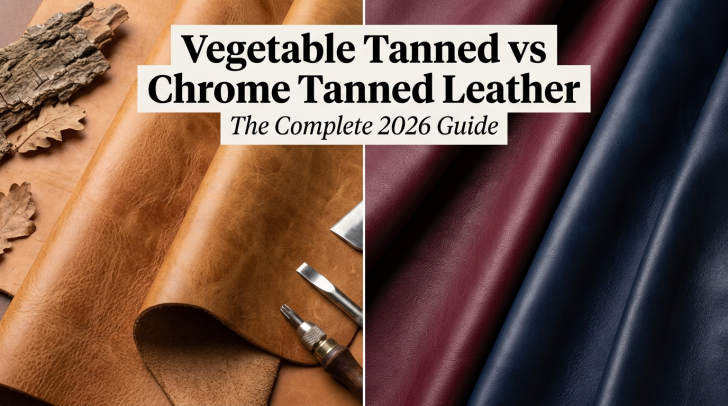
Vegetable tanning is the original tanning method — humans have been doing it for thousands of years. The “vegetable” in the name refers to the natural tannins extracted from tree bark (oak, chestnut, mimosa, quebracho), leaves, and other plant materials. These plant-based tannins slowly bond with the collagen fibers of the hide, displacing water and creating a stable, long-lasting material.
How It’s Made
The hide is soaked in pits of progressively stronger tannin solutions. The process is slow and labor-intensive — typically taking 30 to 60 days, and in the case of premium oak bark tanning (still done by tanneries like J & FJ Baker in England), it can take up to 14 months. There are no chemical shortcuts.
What It Looks & Feels Like
New veg-tan leather is typically firm, structured, and stiff, with a natural tan-to-beige color when undyed. It has a distinctive sweet, woody scent — nothing like the slightly chemical smell of cheaper chrome leather. The surface is alive and absorbent: it darkens in sunlight, drinks in oils from your skin, and records every scratch, fold, and adventure.

What It’s Used For
Veg-tanned leather is the go-to choice for items where structure, longevity, and character matter more than initial softness:
- Wallets & cardholders — develops the deepest, most personal patina
- Belts — holds shape, doesn’t stretch like a “wet noodle”
- Saddles, holsters, knife sheaths — can be molded wet and locked into shape when dry
- Tooled & carved leather — only veg-tan accepts stamped impressions cleanly
- Heirloom bags — built to outlive their owners
Chrome Tanned Leather: The Modern Standard
Chrome tanning was invented in 1858 and rapidly took over the leather industry. Instead of plant tannins, this method uses chromium sulfate salts to bond with the collagen fibers. The chemistry is the same in spirit — displace the water, stabilize the fibers — but the process is dramatically faster.
How It’s Made
Hides are soaked in chromium salt solutions. The entire tanning step can be completed in a single day. After tanning, the leather emerges with a distinctive bluish tint (this is why semi-finished chrome leather is called “wet blue” in the industry). It’s then dyed, finished, and shipped — typically reaching the consumer within weeks of slaughter.
What It Looks & Feels Like
Chrome-tanned leather is soft, supple, and ready-to-wear from day one. There’s no stiff break-in period. It accepts dye beautifully, which is why nearly every brightly colored leather product (red handbags, electric blue boots, fashion jackets) is chrome tanned. It’s also more water-resistant, heat-resistant, and stain-resistant initially.
What It’s Used For
Chrome tanning dominates anywhere softness, color variety, or speed of production matters:
- Leather jackets & garments — needs to drape and flex with the body
- Shoes & boots — soft uppers, comfort on day one
- Gloves — flexibility is non-negotiable
- Furniture & car interiors — uniform color, scratch resistance
- Fashion handbags — bold colors, polished finishes
Side-by-Side Comparison Table
| Feature | Vegetable Tanned | Chrome Tanned |
|---|---|---|
| Tanning Agent | Plant tannins (bark, leaves) | Chromium sulfate salts |
| Production Time | 30–60 days (up to 14 months) | ~1 day |
| Initial Feel | Firm, structured | Soft, pliable |
| Patina Development | Rich, deep, personal | Minimal — color stays uniform |
| Color Variety | Limited (earthy tones) | Virtually unlimited |
| Water Resistance | Moderate | Higher (initially) |
| Scratch Resistance | Lower (marks easily) | Higher (flexes instead of scratching) |
| Lifespan | Decades (heirloom-grade) | 5–15 years typically |
| Eco-Friendliness | High (biodegradable) | Lower (chemical wastewater) |
| Cost | Higher | Lower |
| Scent | Sweet, woody, natural | Slightly chemical |
| Best For | Wallets, belts, holsters, heirloom goods | Jackets, shoes, gloves, fashion bags |
Patina & Aging: The Biggest Visual Difference
If there’s one reason leather enthusiasts obsess over vegetable tanning, it’s patina. Patina is the gradual deepening, darkening, and softening that happens as veg-tan leather is exposed to sunlight, oils from your skin, friction, and time.
🌿 In short: Chrome-tanned leather stays the same. Vegetable-tanned leather becomes something — uniquely yours, shaped by how you live with it.
The transformation is striking. A brand-new natural veg-tan wallet starts a pale, almost beige color. Within weeks of pocket carry, it begins to warm. After six months, the high-touch areas darken noticeably and a soft sheen appears. After a year of daily use, the same wallet looks like an entirely different object — deep amber-brown, glossy where your fingers rest, with the kind of character no factory can manufacture.
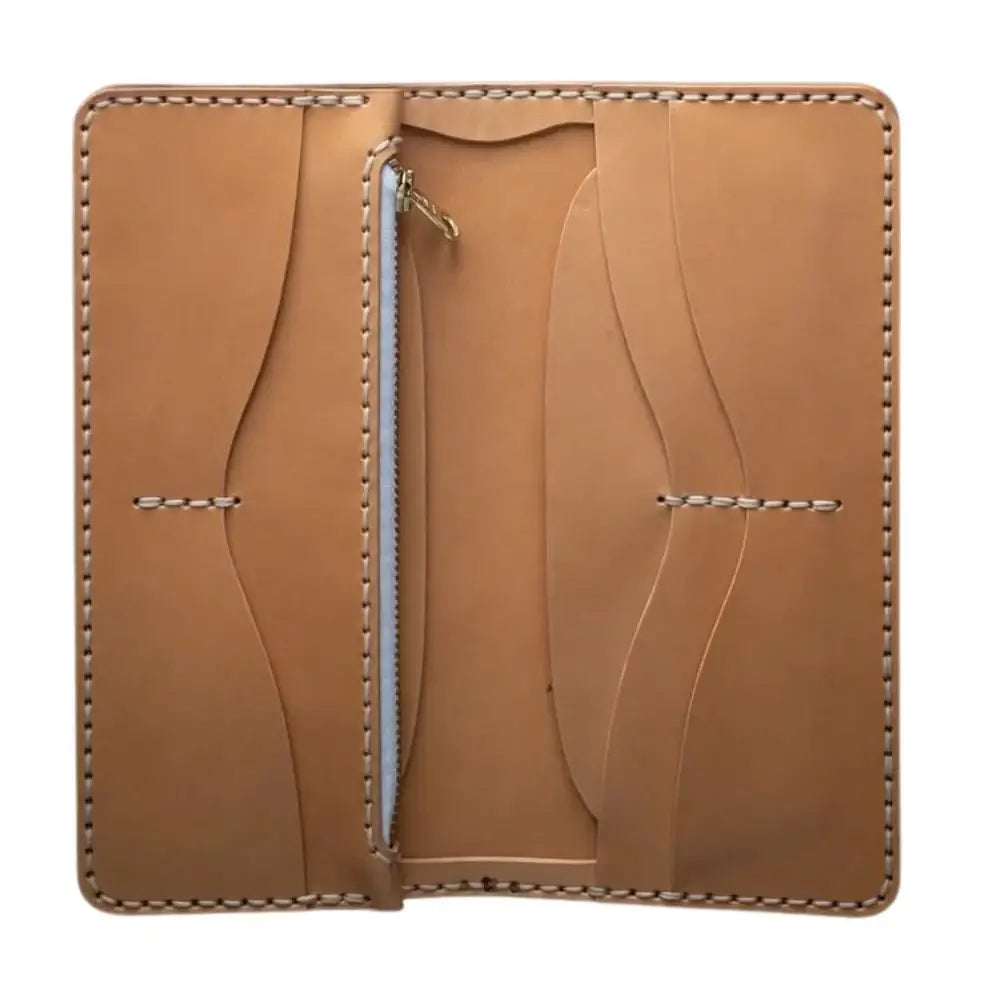
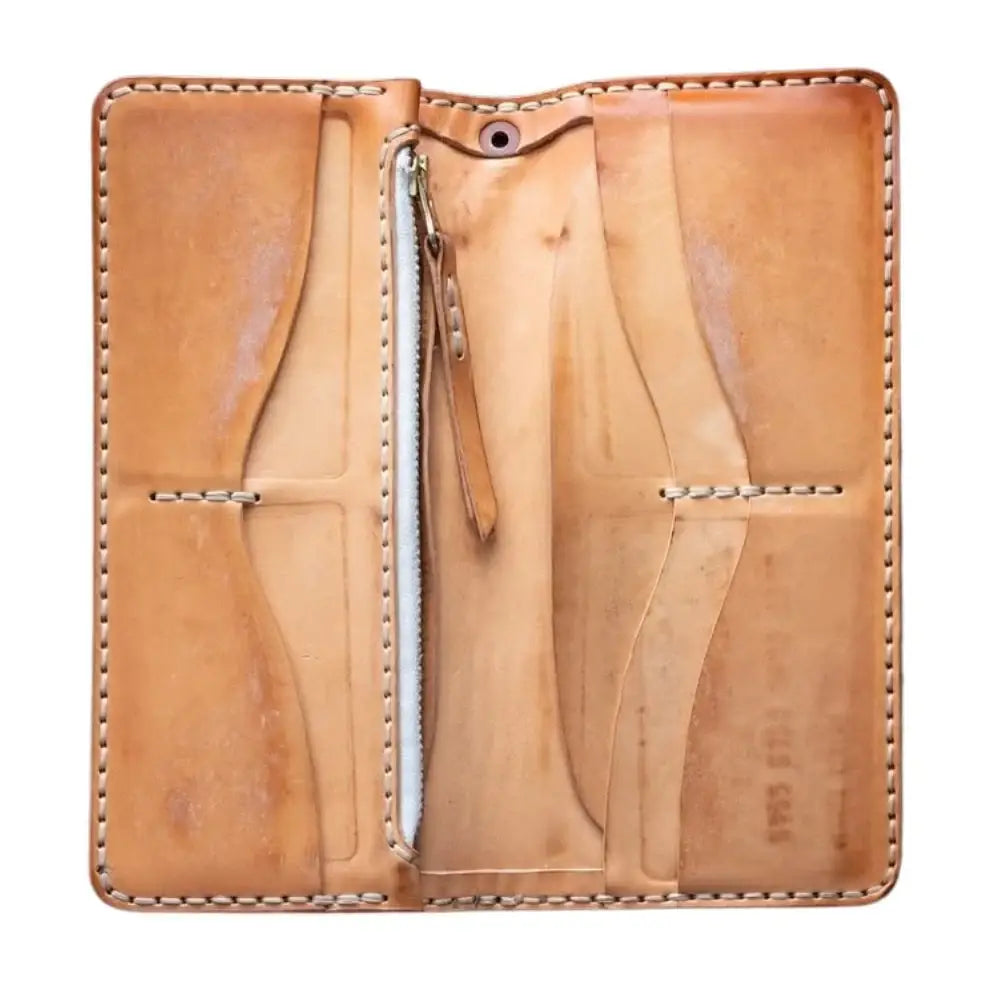
Why doesn’t chrome leather do this? Because chrome tanning seals the leather’s pores. Combined with the heavy pigment finishes that almost always accompany chrome tanning, the surface becomes essentially impermeable. Oils, sunlight, and air can’t penetrate — so the leather can’t change. It stays exactly as it was the day it left the factory, until it eventually wears down.

Important nuance: Patina only develops on full-grain, unfinished or aniline-finished veg-tan leather. If your “vegetable tanned” wallet has a heavy pigmented or sealed finish, the patina effect will be muted or absent. Always look for full-grain + vegetable tanned together for the best aging.
Durability, Water Resistance & Daily Use
This is where things get interesting — and where a lot of online articles oversimplify. The honest answer is: “durability” depends entirely on what you mean by durable.
If You Mean “Lasts the Longest”
Vegetable-tanned leather wins. With basic care, a quality veg-tan wallet or belt can last 30–50+ years and often becomes a generational heirloom. Chrome-tanned leather, particularly cheaper varieties, typically shows wear (cracking edges, finish flaking, structural breakdown) much sooner.
If You Mean “Resists Scratches and Stains”
Chrome-tanned leather wins. Its softness allows it to flex when something presses or scrapes against it, where veg-tan would mark. Try this test: drag a fingernail across both at light pressure. Veg-tan picks up a clear line; chrome leather barely registers it. The pigmented finish on most chrome leather also resists stains better.
If You Mean “Handles Water”
Chrome wins on day one. Veg-tan leather can absorb water, darken unevenly, and stiffen if it dries improperly. But properly conditioned veg-tan handles occasional rain just fine. For genuinely wet environments — boating, hiking in storms, work boots — chrome tanning is the safer bet.
If You Mean “Holds Shape”
Veg-tan, by a mile. Make a belt out of pure chrome leather and it stretches like an old sock. Make a structured handbag from chrome leather and it sags. Veg-tan holds form — that’s why saddles, holsters, knife sheaths, and high-end structured bags all use it.
Environmental & Health Impact
This is the area where the gap between the two methods is the most stark — and where transparency from brands matters most.
Vegetable tanning is generally considered the more sustainable option. The tannins are biodegradable, the wastewater is much less toxic, and finished veg-tan leather will eventually return to the earth without leaving harmful residues. The trade-off is that it uses more water overall and requires far more time and skilled labor.
Chrome tanning has a much heavier environmental footprint. The chromium salts and acids used can produce toxic wastewater that, in poorly regulated facilities (often in developing countries), gets dumped into local waterways. Chromium-VI in particular is a known carcinogen and a serious health hazard for tannery workers and surrounding communities.
For consumers worried about chemicals contacting their skin (in wallets, watch straps, or shoes), some specifically seek out chrome-free leather. The international standard for verified chrome-free leather is IUC 8 testing, which most reputable veg-tan tanneries can document.
Which One Should You Actually Buy?
Here’s the practical decision framework. Forget the marketing — match the leather to the use case.
✅ Choose Vegetable Tanned if:
- You want a wallet, belt, cardholder, or small leather good that ages with you
- You value patina and want something that gets more beautiful with use
- You want a piece that can last decades with basic care
- You care about environmental impact or chrome-free materials
- You appreciate traditional craftsmanship and natural materials
- You’re buying a structured bag that needs to hold its shape
✅ Choose Chrome Tanned if:
- You want a leather jacket, gloves, or shoes that are soft and ready-to-wear
- You need a specific bold color (red, blue, green, etc.)
- You’ll use the item in wet or harsh conditions
- You want lower upfront cost without sacrificing leather quality entirely
- You need uniform color across many pieces (e.g., furniture upholstery)
- You don’t want a break-in period
The hidden third option: combination tanning. Some leathers — like Horween’s famous Chromexcel or traditional Latigo — are retanned, starting with chrome tanning and finishing with vegetable tannins. The result combines chrome’s softness with veg-tan’s character and patina potential. It’s an excellent compromise for boots, work bags, and items that need both durability and depth.

Recommended Products on Amazon & Rakuten
If you’ve decided veg-tan is the way to go for your next wallet or accessory, here are well-reviewed options worth considering. Prices and availability change, so always verify on the linked retailer.
For Vegetable Tanned Leather
- Tanner Goods Minimal Bifold Wallet (Amazon) — Made in the USA from Wickett & Craig veg-tan skirting leather. One of the most respected names in the small-batch leather world.
- IJUN Handmade Vintage Bifold (Amazon) — Full-grain Italian veg-tan with a mild oil finish, well-priced for the quality of materials.
- AULIV Veg-Tan Bifold with RFID (Amazon) — Budget-friendly entry point with full-grain veg-tan and RFID protection.
- Vegetable Tanned Leather Wallets (Rakuten) — Wide selection of Japanese-made veg-tan goods from brands like Tochigi Leather and Yuhaku.
For Chrome Tanned Leather (Soft Goods)
- Men’s Lambskin Leather Jackets (Amazon) — Soft, supple lambskin works best chrome-tanned for drape and comfort.
- Leather Jackets Selection (Rakuten) — Japanese and imported leather outerwear.
💡 Buyer’s tip: When a listing just says “genuine leather,” that’s a red flag — “genuine” is actually one of the lowest grades of real leather. Look specifically for “full-grain vegetable tanned leather” in the description, plus mention of the tannery (e.g., Wickett & Craig, Horween, Tochigi, Italian Tuscany).
Frequently Asked Questions
Q. Is vegetable tanned leather better than chrome tanned leather?
Neither is universally “better” — they’re built for different purposes. Vegetable tanned leather is better for items where character, longevity, and patina matter (wallets, belts, structured goods). Chrome tanned leather is better for items where softness, color variety, and water resistance matter (jackets, gloves, shoes). For heirloom-grade everyday carry, veg-tan is generally the higher-quality choice.
Q. Can vegetable tanned leather get wet?
Yes, but be careful. Veg-tan leather can absorb water, which may cause uneven darkening or temporary stiffness. If your veg-tan item gets wet, blot off excess water with a soft cloth, let it air-dry slowly at room temperature (never near direct heat), and condition it once fully dry. Avoid prolonged soaking.
Q. How long does vegetable tanned leather last?
With basic care, full-grain vegetable tanned leather goods commonly last 30 to 50+ years. Many become heirloom pieces passed down through generations. Quality conditioning every few months and protection from prolonged water exposure are the main maintenance requirements.
Q. Why is chrome tanned leather cheaper?
Three reasons: the chemical tanning process takes about a day instead of months, it requires less skilled labor, and chrome tanning yields more usable leather per hide because it can soften lower-quality hides effectively. The cost difference is mostly time and labor, not raw material cost.
Q. How do I tell if leather is vegetable tanned or chrome tanned?
A few visual and tactile cues: veg-tan tends to be firmer and has a sweet, woody scent; chrome leather is softer and has a faint chemical odor. Undyed veg-tan is a natural beige-tan color, while undyed chrome leather has a subtle blue-gray tinge. The most reliable test is to check a cut edge — chrome leather often shows a gray-blue core. Always check the product description for explicit confirmation.
Q. Does chrome tanned leather develop a patina?
Generally, no — or very little. Chrome tanning seals the leather’s pores and most chrome leather has heavy pigmented finishes that prevent absorption of oils and light. You may see slight darkening over years of heavy use, but nothing like the dramatic transformation of full-grain veg-tan leather.
Q. Is vegetable tanned leather safe for sensitive skin?
Yes. Because it’s processed with plant-based tannins instead of chromium salts, veg-tan leather is widely considered the better choice for those with chrome allergies or sensitive skin — particularly for items in prolonged skin contact like watch straps, belts, or shoes worn without socks.
Q. Can I use leather conditioner on both types?
Yes, but the approach differs. Veg-tan benefits more from conditioning since it’s drier and more porous — apply a small amount every 3–6 months. Chrome leather has built-in oils and finishes; over-conditioning can leave a greasy film. For chrome leather, condition only when it visibly feels dry. Use a quality, leather-specific product in either case.
Final Thoughts
The “veg-tan vs chrome-tan” debate isn’t really a debate — it’s a question of matching the material to the job. If you want leather that becomes a record of your life, develops character, and lasts decades, vegetable tanning is unmatched. If you want soft, colorful, water-resistant leather that performs from day one, chrome tanning is the right tool.
The most important takeaway: quality matters more than tanning method. A top-tier chrome-tanned jacket from a reputable tannery will outlast a poorly made veg-tan wallet from a no-name brand. Look for full-grain leather, named tanneries, and transparent sourcing — and the rest will follow.
Whichever you choose, real leather rewards the people who use it. So pick the right one for your life — and start putting it to work.