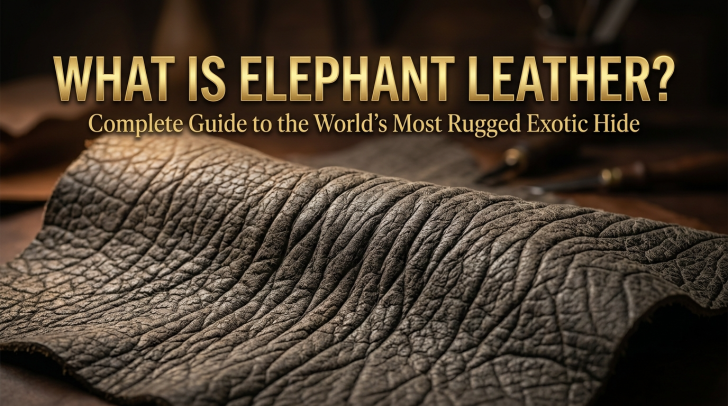
Among all exotic leathers in the world, few materials carry as much weight—both literally and culturally—as elephant leather. With its deeply ridged, almost tectonic surface and near-indestructible toughness, it occupies a niche that crocodile, ostrich, and stingray simply cannot fill. But genuine elephant hide also sits at the intersection of luxury craftsmanship and serious legal regulation, which is exactly why so many leather enthusiasts find it fascinating—and confusing.
This guide explains exactly what elephant leather is, where it comes from, how it looks and feels, what it is legal to buy, how to care for it, and how to spot fakes. Whether you are considering your first pair of elephant skin boots or simply curious about the world’s most rugged exotic hide, everything you need to know is below.
Table of Contents
- What Is Elephant Leather?
- Texture, Grain & Appearance
- African vs. Asian Elephant Leather
- Legality and CITES Regulations
- Key Characteristics & Durability
- Common Products Made from Elephant Leather
- Care and Maintenance
- Real Elephant Leather vs. Embossed Imitations
- Price Range & Where to Buy
- Ethical Considerations
- Frequently Asked Questions (FAQ)
- Conclusion
What Is Elephant Leather?
Elephant leather is an exotic hide produced from the skin of African elephants (Loxodonta africana). It is widely regarded as one of the thickest, toughest, and most distinctive leathers available anywhere in the world. The hide is normally sold as a “panel” rather than a traditional shaped skin, because elephants are far too large to be tanned into a single conventional hide.
A single elephant hide is enormous—legitimate suppliers typically sell pre-cut panels averaging around 20 square feet, with full panels reaching up to 30 square feet or more. The skin is so thick that, in raw form, it can be over 2.5 cm deep, which is part of the reason finished elephant leather products feel so substantial in the hand.

Different parts of the elephant produce different leathers. The body produces “panels,” which are the standard rough, deeply textured material used for boots, holsters, and upholstery. The ears, by contrast, are thinner and noticeably smoother, and they are commonly used for wallets, cardholders, and pool cue wraps. The trunk produces yet another texture and is used in smaller, premium-priced goods.
Texture, Grain & Appearance
The single most recognizable feature of elephant leather is its deep, distressed, wrinkled grain. Unlike cowhide, which has a relatively uniform pebbled surface, elephant skin is full of valleys, ridges, and irregular cracks that look almost like aerial photos of cracked earth. No two pieces are alike, and a finished product carries a one-of-a-kind pattern.
Texture varies significantly across a single hide:
- Body panels: coarse, deeply ridged, with the most dramatic grain
- Shoulders and back: the deepest grooves and most “carved” appearance
- Belly area: slightly smoother and more pliable
- Ears: the smoothest sections, often used for slim wallets
- Trunk: rounded ribs, prized for its rarity
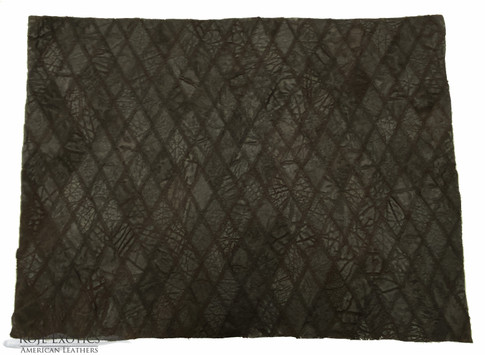
Color in finished elephant leather is most often natural gray, but tanneries also produce it in chocolate brown, black, tobacco, cognac, and increasingly in dyed shades like burgundy and navy. The deeper, more rugged the grain, the thicker the panel must be — for very fine work, smoother sections are required because the leather cannot be skived (thinned) below about 1.2 mm without losing structural integrity.
African vs. Asian Elephant Leather
This is one of the most important distinctions in the entire elephant leather industry, and it has direct legal consequences for buyers.
| Feature | African Elephant (Loxodonta africana) | Asian Elephant (Elephas maximus) |
|---|---|---|
| CITES Status | Appendix II (limited legal trade) | Appendix I (commercial trade banned) |
| Texture | Coarse, deeply ridged, dramatic grain | Smoother, finer, less pronounced grooves |
| Source Countries | Zimbabwe, South Africa, Namibia, Botswana | Trade prohibited internationally |
| Availability for Buyers | Legal in most jurisdictions with documentation | Effectively unavailable as new product |
| Common Use | Boots, wallets, belts, holsters, upholstery | Antique pieces only (pre-1975) |
In short: any genuinely new, legally produced elephant leather product on the market today is almost certainly made from the African species. If a seller claims to offer “Indian” or “Asian” elephant leather, it should be considered a serious red flag unless documented as a verified pre-1975 antique.
Legality and CITES Regulations
Elephant leather is governed internationally by CITES — the Convention on International Trade in Endangered Species of Wild Fauna and Flora. CITES is a treaty among 184 countries that regulates trade in vulnerable species. Its key features for elephant leather buyers are:
- Appendix I species — fully banned in commercial international trade. Asian elephants fall here.
- Appendix II species — trade is permitted with permits and documentation. African elephants fall here, though only from countries with managed populations (Zimbabwe, South Africa, Namibia, Botswana).
- Each shipment requires an export permit from the source country and an import permit at the destination.
Within the United States, owning legally imported African elephant leather is permitted at the federal level under CITES Appendix II rules, but several states impose their own bans. California, New York, and New Jersey currently restrict the sale of elephant skins regardless of CITES status. Buyers should always check local laws before importing or transporting elephant leather goods.
For more on international wildlife trade regulations, see the official CITES website and the U.S. Fish & Wildlife Service.
Key Characteristics & Durability
Elephant leather has a reputation as one of the hardest-wearing leathers ever brought to market. Its core qualities include:
- Exceptional thickness — typical finished thickness is 1.5 to 3 mm, sometimes more
- High abrasion resistance — resists scuffing far better than calfskin
- Puncture resistance — often described as the most puncture-resistant leather available
- Long fiber structure — makes it flexible for footwear despite being thick
- Breathability — boots made from it stay surprisingly comfortable
- Develops a patina — softens and gains character with use
It has trade-offs, however. Elephant leather is described as somewhat “dry” — it lacks the natural oils of cowhide, so it can stiffen or lose color if neglected. It also does not take a high polish in the way cordovan or calfskin does; it should be conditioned, not polished, to preserve its matte texture.
Common Products Made from Elephant Leather
Because elephant hide is thick and rugged, it is naturally suited to products that need durability and visual presence. Some of the most popular categories include:
- Cowboy boots and Western boots — the classic and most iconic use
- Wallets and bifolds — usually made from the smoother ear sections
- Belts — perfect because long straight cuts are easy to obtain
- Gun holsters and rifle slings — durability is unmatched
- Pool cue wraps — for grip and a luxe feel
- Motorcycle seats and biker accessories
- Custom luxury car interiors — used by select luxury automakers
- Watch straps — for unmatched ruggedness

If you are looking to start with an elephant leather piece, a wallet is usually the easiest entry point. Examples of widely available genuine elephant leather goods include:
- Cuadra Genuine Elephant Leather Bifold Wallet — handmade in Mexico, available on Amazon and through Western retailers
- Yoder Leather Elephant Bifold Wallet — CITES-certified African hides
- Alligator Jake’s Elephant Biker Wallet — handcrafted in Florida, USA
- Lucchese Classics Elephant Boots — premium handcrafted Western boots
You can browse current selections on Amazon or compare options on Rakuten for international shipping.
Care and Maintenance
Elephant leather is robust, but it needs the right care — not the same routine you would use on cow leather. Because the surface is matte, deeply textured, and somewhat dry, certain common leather treatments will actually damage it.
Daily and Weekly Care
- Wipe off dust with a soft, dry or slightly damp cloth — never soaking wet
- For deeper grooves, gently brush along the natural grain with a soft-bristle brush
- Allow the leather to dry naturally if it gets damp — never near heat sources
- Store in a dry, well-ventilated place out of direct sunlight
Conditioning
Conditioning should be done sparingly — perhaps every 3 to 6 months for boots in regular wear. Use a conditioner formulated for exotic leathers; avoid heavy oils like neatsfoot oil if you want to preserve the original color, since they will darken the leather. Apply a thin coat with a lint-free cloth using small circular motions, let it absorb fully, and then buff lightly.
What NOT to Do
- Do not polish — it strips the natural matte finish
- Do not use harsh chemical cleaners — they remove natural oils
- Do not soak — water can stain and stiffen the hide
- Do not expose to direct sunlight for long periods — it fades the color
- Do not over-condition — too much oil softens it past the point of usefulness
Nubuck-finished elephant leather (a velvety, brushed finish used by some makers like Zonkey Boot) requires a different routine — it should be cleaned with a suede eraser and brush, and conditioners should be avoided altogether.
Real Elephant Leather vs. Embossed Imitations
Because genuine elephant leather is expensive and tightly regulated, the market is full of cowhide that has been pattern-stamped to mimic the look. This is sometimes labeled honestly as “elephant print” or “elephant grain embossed,” but other times it is misleadingly described as “elephant leather.” Knowing how to tell the difference saves money and prevents legal issues.
| Indicator | Genuine Elephant | Embossed Cowhide |
|---|---|---|
| Grain Pattern | Irregular, asymmetric, unique to each piece | Repeating pattern across the panel |
| Thickness | 1.5–3 mm or thicker, very rigid | Usually thinner and more flexible |
| Edges (cut surface) | Coarse, fibrous, layered look | Uniform, often plastic-coated |
| Documentation | CITES paperwork available | None — no exotic species used |
| Price | Premium ($150+ for small wallets, $1,500+ for boots) | Significantly cheaper |
| Smell | Distinctive, deep leather aroma | Often mild or chemical |
If a seller cannot produce CITES documentation for a genuine elephant skin product — or refuses to clarify whether the leather is real or embossed — it is almost certainly a fake.
Price Range & Where to Buy
Elephant leather products sit firmly in the luxury exotic category. Approximate price ranges are:
- Card holders & small wallets: $80 – $200 USD
- Bifold wallets: $150 – $350 USD
- Belts: $200 – $600 USD
- Cowboy boots: $700 – $2,500+ USD
- Custom holsters & goods: $250 – $700 USD
- Raw panels (for makers): $25 – $50 USD per square foot
Reputable sources include established Western boot makers, exotic leather wholesalers like Roje Exotic Leather and Exotic Skin (American Exotics), and specialty makers such as Lucchese. For broader online shopping, search dedicated listings on Amazon and Rakuten — but always verify CITES compliance before purchasing.
Ethical Considerations
Elephant leather is one of the most ethically debated materials in the leather world, and any honest guide must address this directly. Two camps exist:
The conservation argument: Supporters note that legal elephant hides come from regulated population management programs in southern African countries where elephant populations are stable or growing, and where unmanaged herds can damage ecosystems and threaten human communities. In this view, legal trade in elephant leather is a sustainable byproduct of necessary wildlife management.
The animal welfare argument: Critics argue that even legal trade creates demand that incentivizes poaching elsewhere, and that elephants are highly intelligent, social animals whose use as a luxury material raises serious moral concerns. Some major retailers (including Tesla and certain Nike collections) have voluntarily stopped using exotic leathers entirely.
Both perspectives are valid, and reasonable people disagree. If you choose to buy elephant leather, the most responsible approach is to insist on:
- Verifiable CITES documentation
- Transparent supply chain information
- Sourcing from countries with managed populations
- Avoidance of any “Asian” or “Indian” elephant claims
Frequently Asked Questions (FAQ)
Is elephant leather legal to own?
Generally yes, if it is sourced from African elephants under CITES Appendix II and accompanied by proper documentation. Three U.S. states — California, New York, and New Jersey — restrict in-state sales. Always check your local laws.
How can I tell if my elephant leather is real?
Look for an irregular, non-repeating grain pattern; significant thickness (usually over 1.5 mm); a fibrous cut edge; and documentation from the seller. Embossed cowhide will have a repeating uniform pattern.
Is elephant leather more durable than cowhide?
Yes — substantially. Elephant leather has higher puncture and abrasion resistance, and finished products often last decades with proper care. It is sometimes called the most puncture-resistant leather available.
Why is elephant leather so expensive?
The supply is legally limited, the hides require specialized tanning, the import process involves CITES permits and federal inspection, and finished products are typically made by skilled exotic-leather artisans in low-volume runs.
Can I travel internationally with an elephant leather product?
You may need a CITES re-export or personal-effects certificate depending on your origin and destination countries. Contact your national CITES authority before flying, especially if you are heading to or through the EU, UK, Australia, or New Zealand, where checks have intensified.
How does elephant leather age?
It develops a beautiful patina over time, softening slightly and deepening in color. The grain becomes more pronounced as the hide flexes through years of use. With conditioning every few months, an elephant leather wallet or pair of boots can easily last 20+ years.
What’s the difference between elephant ear leather and elephant panel leather?
Ear leather is thinner and smoother, making it ideal for slim wallets, watch straps, and pool cue wraps. Panel leather (from the body) is thick and deeply ridged, used for boots, belts, and holsters.
Conclusion
Elephant leather is genuinely unlike any other material in the leather world. Its dramatic, deeply ridged grain, near-indestructible toughness, and rich legal heritage place it firmly in the rarified category of materials that combine craftsmanship, conservation, and luxury. For collectors and enthusiasts who appreciate exotic hides, a properly sourced elephant leather wallet or pair of boots is a piece that can outlast almost anything else in a wardrobe.
That said, this is not a casual purchase. Always insist on CITES documentation, buy from established makers, understand your local laws, and care for the leather correctly. Done right, an elephant leather product becomes a generational item — one with a story, a pedigree, and a presence that no embossed cowhide can fake.